Handvantage
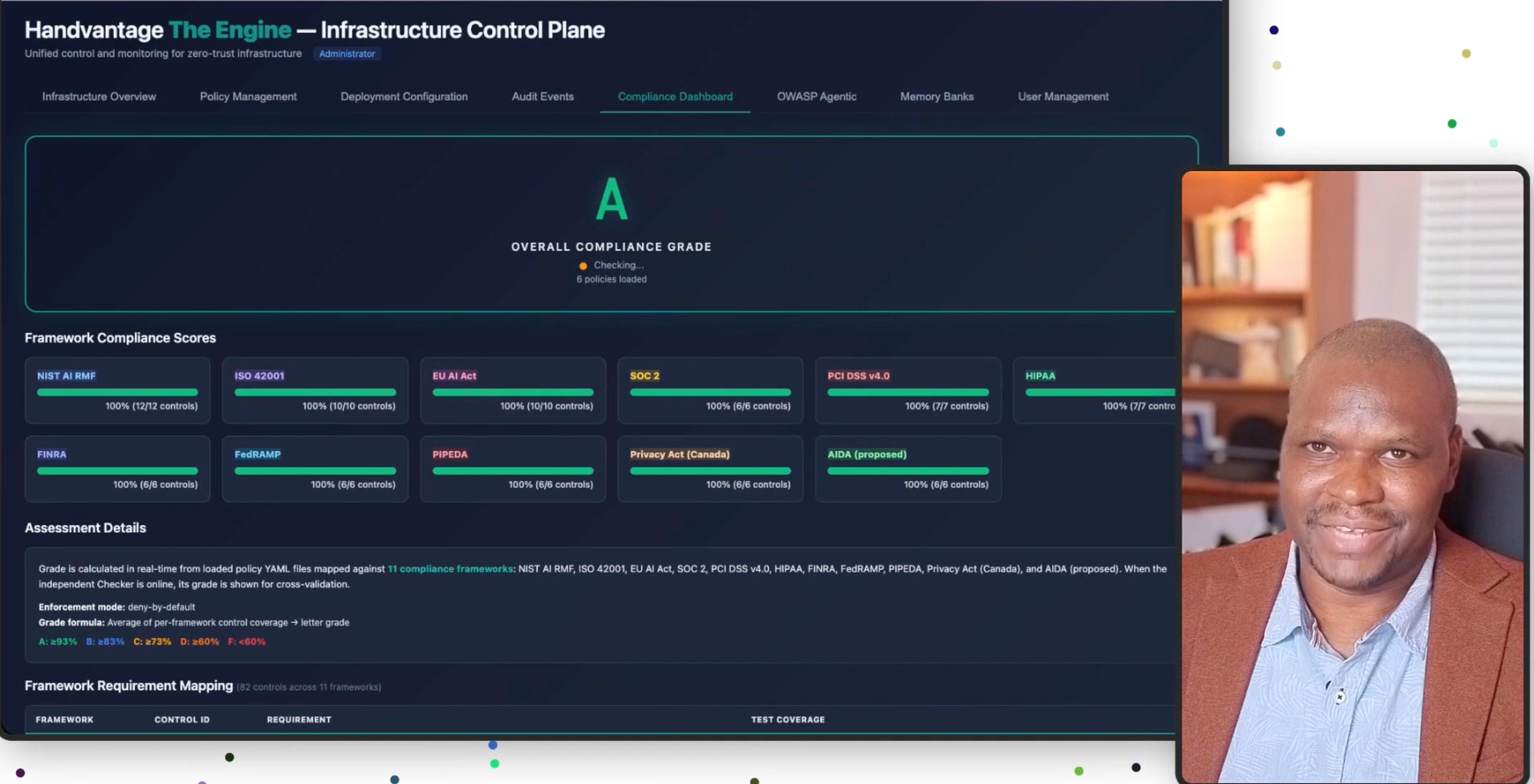
Josh Olayemi, founder of Handvantage, walking through Vantage Workspace.
Josh Olayemi · founder · in-session

FROM A FOUNDER · MAY 2026

Why we built Handvantage.

An essay on the architecture choices behind Vantage Workspace — the Sovereign Capability Partner thesis, the Pilot + Fleet model, and why the audit window had to become structural rather than optional.

About 8 minutes. By Josh Olayemi.


I started Handvantage in 2024, in Toronto, after eighteen months of trying to assemble an “agentic AI stack” for clients out of the parts the major vendors were shipping. The work was honest and the clients were good. The pattern I kept hitting was less honest. Every individual piece of the stack existed. The integration was always the project.

The identity layer was someone else's product. The audit layer was something my engineers had to build because the vendors had each implemented their own format and none of them reconciled. The compliance evidence layer was three weeks of consultancy hours, twice a year, and during the eleven-and-a-half months in between, the only artefacts were Slack messages.

Two things happened in late 2024 that pushed me to start building rather than continue assembling.

The first was a conversation with a CISO of a mid-cap financial services firm in London. We were three hours into a workshop about her firm's planned ChatGPT Enterprise rollout. She had read the OWASP Top 10 for Agentic Applications carefully — far more carefully than the vendor's account team had — and she had a list of fifteen questions about controls. Of those fifteen, the vendor could answer four. For the other eleven, the answer was “you'll need to build that yourself, or your existing tooling will need to do it.”

I left the meeting realising she was being asked to take regulatory and reputational risk that the vendor had structurally externalised onto her. The vendor was selling her a product layer. Everything underneath the product layer — identity, audit, compliance evidence, supply chain provenance — was her problem to assemble. She would assemble it, of course; she's good at her job. But she would do so in a thirteen-month sprint, with consultants she'd only met that week, against a regulatory deadline that was closing.

The second thing was a regulatory note from the European Commission. The note clarified what “high-risk” AI systems would be required to evidence under the then-finalising AI Act. Reading the note carefully, I understood something I'd been missing: the audit window was about to become a structural feature of every AI deployment in the EU's economic gravity well. Not a one-time check, not an annual attestation, not a quarterly review — a continuous evidence requirement, generated on every interaction, machine-verifiable, mapped to specific Annex IV technical-documentation requirements.

The CISO's problem and the regulatory note's framing collided in my head. If the audit window was going to be continuous, the evidence had to be continuous. If the evidence had to be continuous, it had to be generated by the platform itself, in the moment, with cryptographic integrity. If it had to be generated by the platform itself, then the platform had to be architected for it from the first commit — not retrofitted via add-on monitoring.

That was the moment Handvantage existed in concept. Vantage Workspace, the platform, took eight more months of building before the v0.1 release.


The hardest decision in the early architecture was whether to be configurable or structural. The first version of the seven-layer defence architecture was configurable — operators could turn off layers, reorder them, run them in parallel. We rationalised this as flexibility, the standard rationalisation in enterprise software. We were wrong.

The reason we were wrong became clear when we ran the first internal /assess mission against a configured deployment. The audit log was contestable. An auditor reviewing the log would reasonably ask: “show us the evidence that Layer 4 was active for every event in the audit window.” The configurability of the layer made that evidence harder to produce. We had created a system that could be made compliant but could not be proved compliant — which is, in the regulatory frame we were targeting, the same as not being compliant.

We rebuilt the architecture as structural. The seven layers are present in every deployment. Their order is fixed. Their evidence outputs are continuous. Operators configure the policies inside a layer, but they do not configure the existence of a layer. The audit log is therefore non-contestable on the question of whether the layers were running — they were, by construction.

This decision cost us a feature that several early prospects had asked for. We lost a few of those prospects. We kept the decision because the regulatory frame we were building for would not have permitted the alternative.


The second hardest decision was whether to be multi-tenant SaaS or single-tenant deployment. Multi-tenant SaaS is the dominant business model in our category, for excellent reasons — it's faster to ship updates, easier to support, and the unit economics are better. Single-tenant deployment is operationally heavier, slower to update across the fleet, and harder to support.

We chose single-tenant deployment for one reason: data sovereignty. Every customer's audit log, policy, evidence, and operating data stays in the customer's environment. We do not have a multi-tenant data lake. We never will. The reason isn't ideological; it's strategic — we are selling to customers (regulated institutions, public-sector bodies, sovereignty-conscious enterprises) for whom the multi-tenant model is a structural objection. The customers are choosing us in part because we made this trade.

The trade-off is what it is. Each customer is a deployment. Each deployment is a thing we have to support. The product roadmap moves slower than it would in a SaaS model. We have accepted that.


The Pilot + Fleet model is the structural answer to the question “what does an agent's permission scope look like?” The default in early agentic AI was: one general-purpose agent, with a permission scope wide enough to cover any action it might take. The failure mode was inevitable — the permission scope ended up being the union of every possible action, which means the agent had god-rights, which means the audit log was meaningless.

We inverted the model. The Pilot orchestrates; it has no direct tool access. The specialists in the Fleet (Hunter, Sentry, Concierge, Analyst) each hold the narrow permission scope required for their specialism. The Pilot delegates; the specialist executes within scope; the audit log records both. Three-level attribution, every time.

The Pilot + Fleet model is not new — academic agentic-AI papers have proposed similar decompositions for years. What's new is shipping it as the default, structurally, with the YAML schema for custom agents in production. The model survives contact with real customer requirements; the YAML is reviewed by the customer's security team before a custom agent is loaded; the runtime enforces the declared scope.

Josh Olayemi walking through The Engine — the operator pane where the platform's runtime architecture is observable.
Walking through The Engine.

The Sovereign Capability Partner thesis is what we say to customers when they ask “what kind of company are you?” We are not a SaaS vendor. We do not sell seats and roll out feature updates centrally. We are not a consultancy. We do not bill by the hour. We are not a systems integrator. We do not assemble third-party products and put a wrapper on them.

We build a capability — Vantage Workspace — and we partner with customers to deploy and operate it inside their sovereignty. The capability is theirs to operate. We're the partner that ships the platform, maintains the architecture, runs the assessment cadence, and stays on the line when something needs to be reasoned about. The relationship is closer to “structural engineer” than to “vendor”.

The Sovereign Capability Partner shape implies certain things about our business. We grow more slowly than a SaaS. We grow more reliably. The customers we work with are inside our long-arc roadmap discussions. The annual meeting cadence is closer to that of an audit firm than to that of a software vendor.

It also implies certain things about how we publish. The compliance page lists not just the certifications but the gaps. The architecture page lists not just the features but the trade-offs. The insights archive includes engineering retrospectives where we describe failures we caught. The pattern is consistent: a Sovereign Capability Partner cannot survive on marketing-grade trust; it survives on engineer-grade trust. Which is harder to earn and worth more once earned.


The last thing I want to name on this page is the work we have not finished yet. The compliance grade is A at 100% across eleven frameworks; that number is the best summary statistic of the platform's posture. It is also, mechanically, an underestimate of how much work remains. The frameworks update. The threat surface expands as agentic AI matures. The regulatory environment is in flux — AIDA in Canada, the AI Act's secondary legislation in the EU, the FTC's evolving guidance in the US.

We will fail something. The discipline that produces the A grade today is the same discipline that will catch the failure when it happens, and the same discipline that will publish the failure transparently. The B-to-A retrospective on the insights archive is one example. There will be more.

If you're reading this page, I hope what comes through is the seriousness of the project. We are not building “AI for the enterprise” in the marketing sense. We are building the structural primitives the next generation of regulated AI deployment is going to need, in a shape that can be inherited rather than re-invented. The customers we want to work with are the ones who recognise the difference.

Josh Olayemi, Founder
May 2026


Josh Olayemi, founder of Handvantage, at his desk.

CONTINUE THE CONVERSATION

If something on this page resonates, talk to us.

We don't run a 'schedule a demo' funnel. The most useful first conversation is the one where you describe what you're working on, and we describe whether the platform's shape fits. Sometimes the answer is yes. Sometimes the answer is 'not quite, but here's a better fit.' Both responses are honest.

Talk to us →

Or write to hello@handvantage.com directly.