
●HANDVANTAGE · CONSULT → PROVE → DEPLOY
Make AI do a real job.
Keep the human
in charge.
Vantage Workspace brings business operations, finance, files, communication, and named AI Workers into one single-tenant environment. Start with one recurring job, keep human approval over consequential actions, and retain evidence a reviewer can inspect.
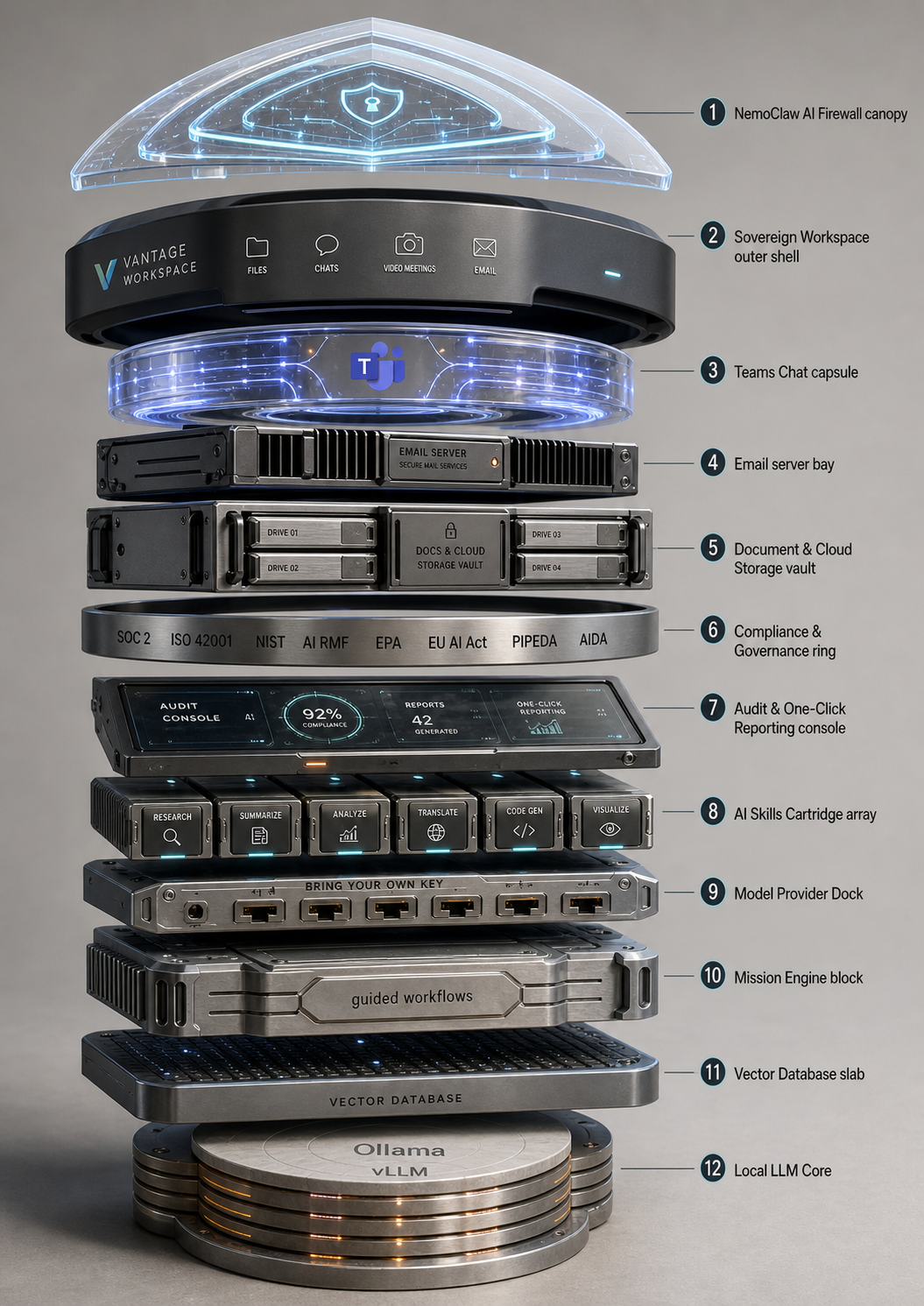
Conceptual composition · not a deployment topology or hardware specification
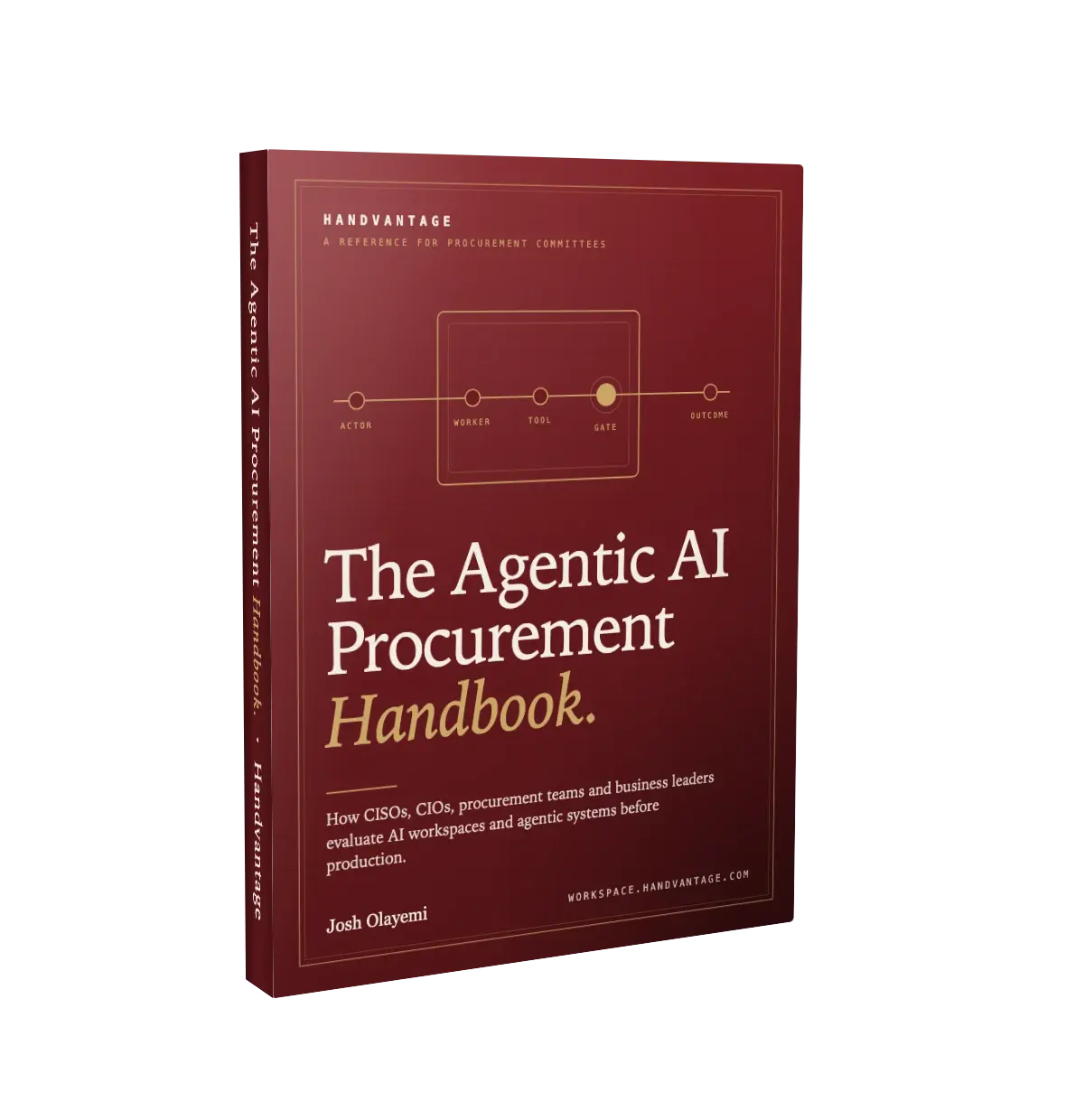
THE HANDBOOK · NO EMAIL GATE
Before your next AI demo, read the buyer's field guide.
The Agentic AI Procurement Handbook is 43 pages, vendor-neutral, and written for the committee that has to approve an AI system and answer for it afterwards. It shows how to decide the category, name the human in the loop, reconstruct one action and break one dependency before anything reaches production.
Get the handbookPDF · 43 pages · announced 18 September 2026
Evidence mapped for review against
- NIST AI RMF
- ISO 42001
- ISO 27001
- EU AI Act
- SOC 2 Type II
- PCI DSS v4.0
- HIPAA
- PIPEDA
- OWASP LLM Top Ten
- TBSDADM
- GDPR
Canadian-operated. Customer-controlled. Evidence templates include Canada's TBSDADM alongside ten international frameworks. Review the sovereignty boundary.
What you get
Business work first. Control where it matters.
Vantage Workspace gives an owner or team one place to prepare decisions, review finance work, manage people operations, collaborate, and assign bounded jobs to AI Workers. The same environment carries identity, approval, model-route, and evidence controls for work that needs closer review.
Named AI Workers for bounded jobs.
Assign a role a source, expected output, human reviewer, approval point, and rejection rule. The role name is not the proof; the observed job and retained record are.
An owner operating brief.
Bring together the activity a business owner needs to review, then keep the decision with the owner. The demonstrated proof shows the source and output rather than inventing ROI.
Finance work under review.
Vantage Books provides a native ERPNext route for customers, invoices, receivables, payables, and summaries. Xero can be added where it fits; ledger changes remain subject to human confirmation.
People operations in the same workspace.
The HR surface supports employee and operating workflows. Access to roster and people data is tested by role, including the denied path when a grant is absent.
Files, mail, chat, and meetings.
The collaboration applications are available through the workspace launcher and shared sign-in. Downstream automation is qualified per workflow before it enters the proof.
A configured model and data boundary.
Customer-approved public, private, or local model routes sit behind the selected identity, policy, and NemoClaw boundary. A local-only route is described separately.
Evidence the buyer can challenge.
Choose one control, rerun it in the evaluation environment, and retrieve the result. Framework mappings organize the review; they do not certify the customer.
Single-tenant deployment choice.
Managed-private, private-cloud, and customer-hosted patterns are scoped to the customer's data, identity, model, support, and operating requirements.
Built for owner-led and mid-market organizations that need AI to help run the business without giving it undefined authority, and for regulated teams and service partners that need a stronger evidence standard.
The shift
Most AI platforms were built for the demo.
Yours has to survive the audit.
The first wave of enterprise AI was a browser tab beside the real work. Buy a license, point it at your data, hope. The proof of value was a screenshot. The proof of safety was an acceptable-use policy in the employee handbook.
The platform's assessment module ships with NIST AI RMF and HIPAA templates active alongside nine other base frameworks, including the EU AI Act. The practical test is not a penalty calculation. It is whether an organization can retrieve the identity, approval, policy, route, and outcome for a demonstrated workflow while the record is still useful.
In the United States, the consequence is distributed across HIPAA enforcement for healthcare, SEC cybersecurity disclosure requirements for public companies, FTC enforcement involving AI claims and data practices, state laws such as the Colorado AI Act, and cyber-insurance underwriting that increasingly asks whether AI controls can be evidenced. Different authorities; the same operational question: can you show what the system did and which controls were running?
Agentic AI doesn't just answer questions. It takes actions on behalf of a user — sends emails, modifies files, queries databases, provisions resources. Each action needs an identity, a permission boundary, an audit log, and a way to roll back. None of that lives in a side tab. All of it has to live in the platform around it.
Your team starts here
One workspace. Shared identity. Evidence for the demonstrated work.
Email, files, chat, meetings, docs — and AI Workers that do the work across all of them. In the demonstrated workflow, model requests pass through the configured boundary and actions leave a named operating record.
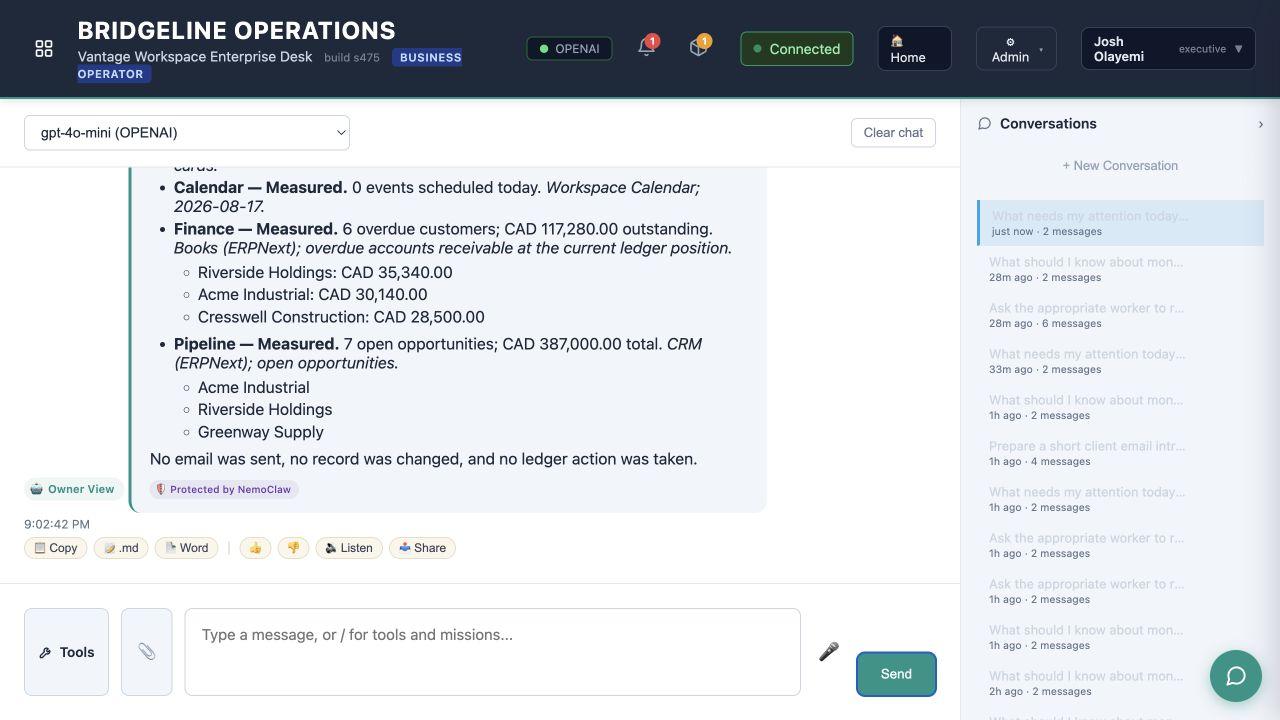
What the team actually does
What changes on Monday morning.
Start with a job the team already recognizes. Each proof names the source, expected output, human reviewer, rejection rule, and record that should remain. The examples below are the current routes to evaluate, not promises of unattended automation.
Prepare one operating brief for the decisions ahead.
Use a bounded workflow to gather the selected operating context into a reviewable brief. The owner keeps the decision; the proof shows the source and the result.
Review close readiness and the exceptions that block it.
Vantage Books provides a native ERPNext route; Xero can be connected where it fits. The buyer proof checks the figures against the selected ledger and holds changes for human confirmation.
Answer workforce questions without opening the whole roster.
The proof exercises live people data and the role gate together: an allowed request, an ungranted request, and the result after a grant is revoked.
Draft the client artifact, then hand it to the reviewer.
Desk can prepare a draft from the approved source. The proof stops short of claiming that the artifact was saved, sent, or published until that handoff is verified.
Run a bounded assessment and inspect the output.
The general and healthcare self-assessment journeys have completed end to end in a controlled demonstration, including PDF output. Other sector routes are qualified before use.
What the platform looks like to your CFO, your COO, your VP Sales, and the team that will actually use it.
The workspace brings its applications, AI Workers, finance surface, and shared sign-in into one operating environment. The page below shows the job, reviewer, and evidence question for each role without inventing a return-on-investment figure.
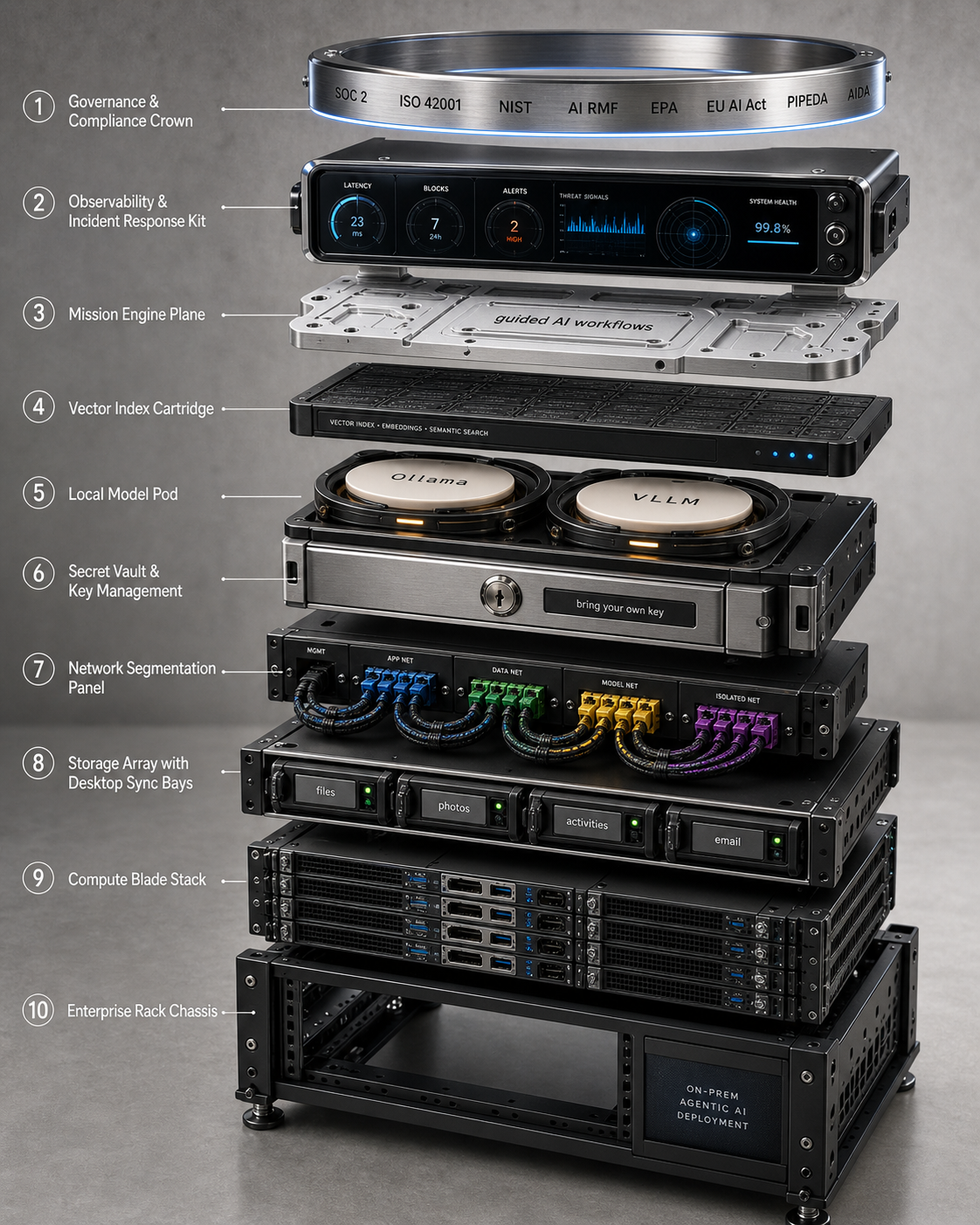
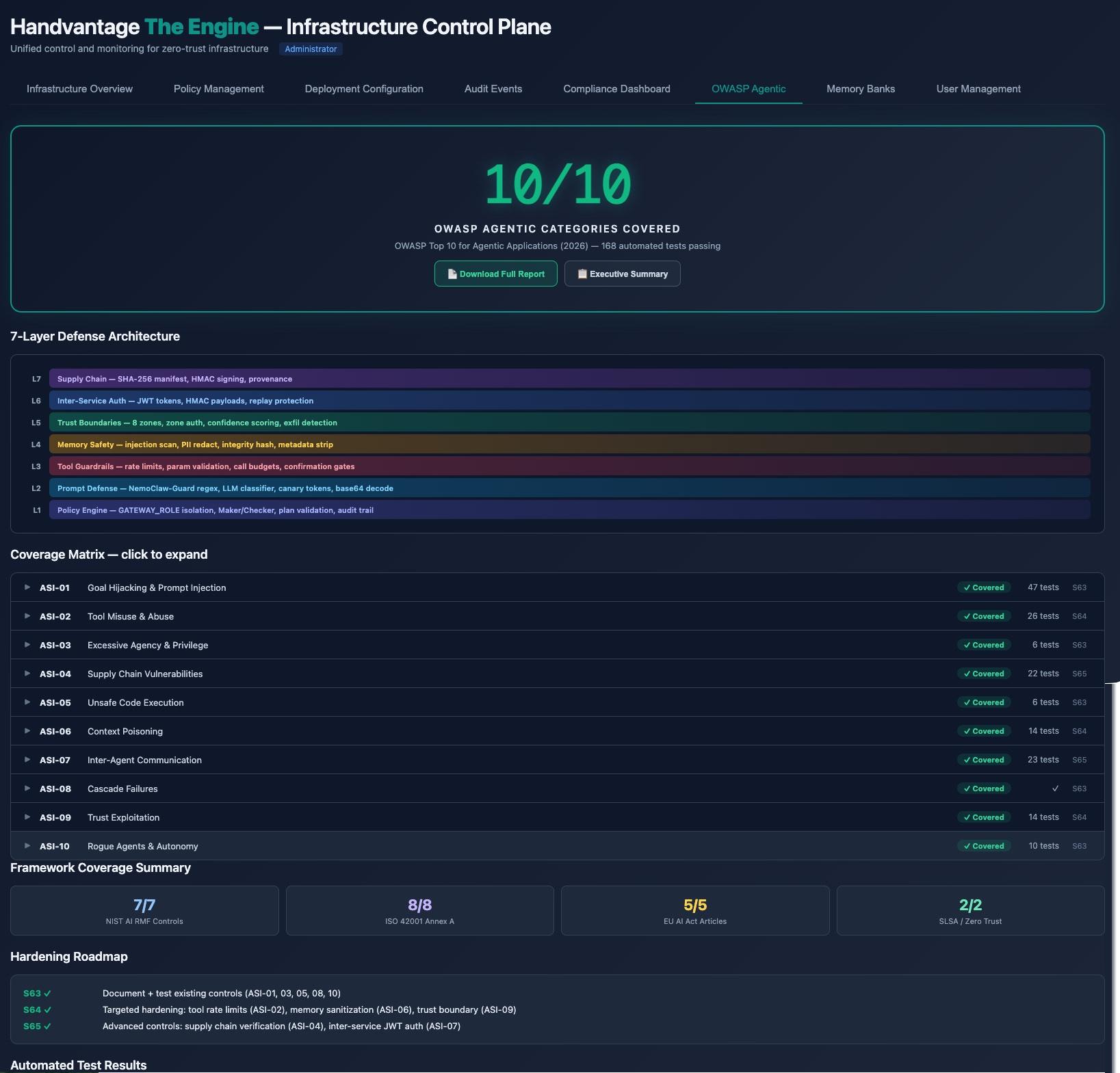
The 7-Layer Defense
Seven control layers. One workflow to inspect.
Each layer addresses a specific failure mode. Each failure mode shows up in OWASP Top 10 for Agentic Applications, in NIST AI RMF, in EU AI Act Annex IV — often all three. The demonstrated configuration lets a reviewer inspect whether the relevant controls produced evidence during the workflow.
- 01Policy EngineDecision recorded
- 02Prompt Defense (NemoClaw)Injection caught
- 03Tool GuardrailsScope-checked at runtime
- 04Memory SafetyTenant-isolated
- 05Trust BoundariesIdentity enforced
- 06Inter-Service AuthEncrypted in transit
- 07Supply ChainSigned at deploy
Build-scoped evidence
Read the assessed deployment.
Then reproduce the result.
The dashboard shows control coverage for the assessed deployment and loaded policy set. The letter is a summary; the useful proof is the evidence behind the tested controls, the assessment window, and the result a reviewer can reproduce.
As of May 5, 2026
A
100% displayed control coverage across 11 base framework mappings.

NemoClaw — the inline firewall
Caught before the model sees it.
NemoClaw applies the configured ingress checks before an approved model route. A buyer proof uses representative content to inspect what was blocked, what was allowed, and what evidence the selected workflow retained.
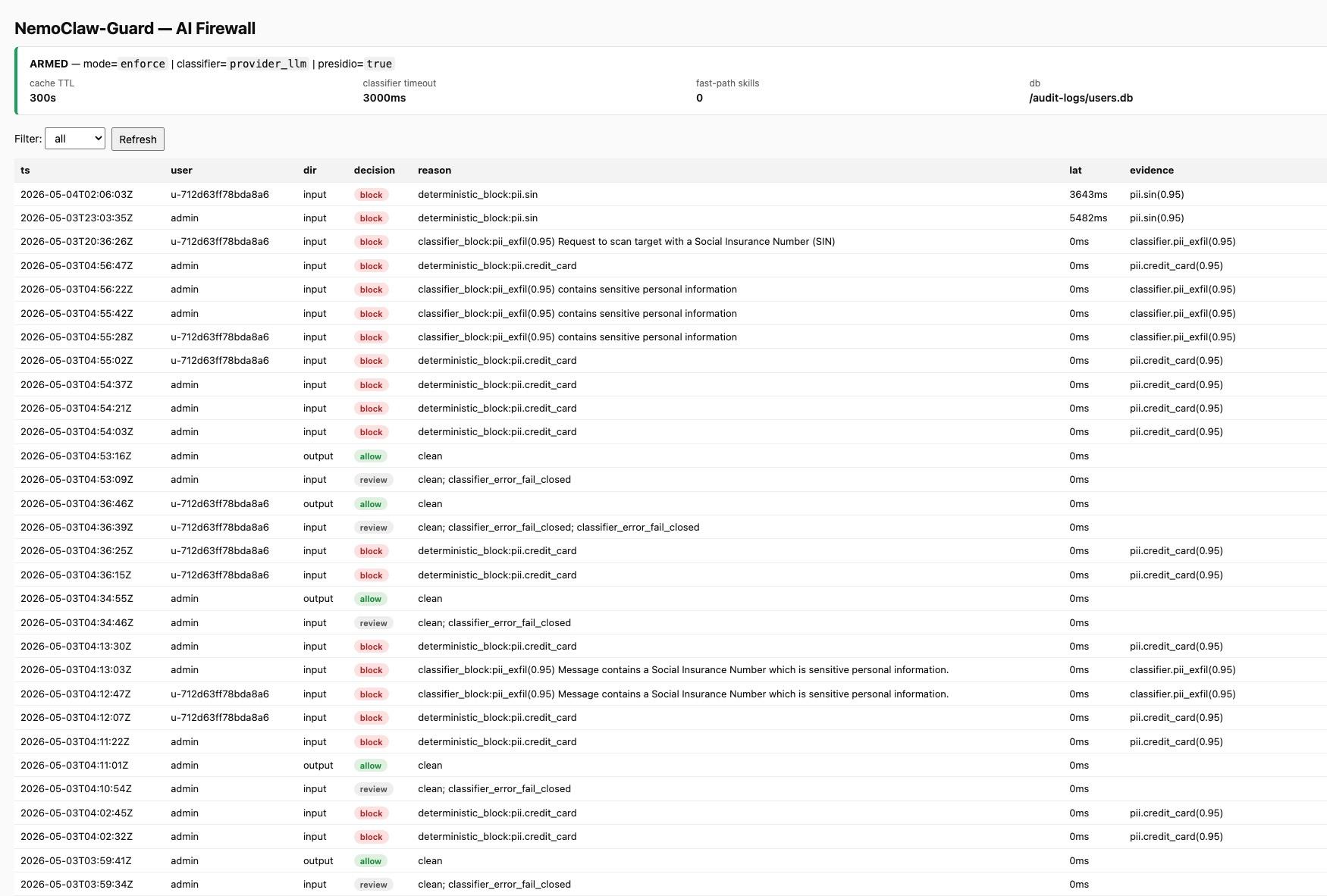
01
Representative source
Choose the content and boundary the reviewer wants to test.
02
Configured route
Name the approved public or local model route for the workflow.
03
Observed decision
Inspect the boundary result rather than accepting an architecture claim.
04
Retained record
Retrieve the attributable event produced by the demonstrated run.

From the founder
“We built Handvantage because the alternative was a project, not a purchase. The identity layer was someone else's. The audit layer was something my engineers had to build. The compliance evidence layer was three weeks of consultancy hours twice a year. Vantage Workspace is the integration.Read the philosophy
Recent thinking
Field notes from the build.
 Retrospective
From B to A: the discipline behind the upgrade
What changed between February and May to move the compliance posture three letter grades. Less novel methodology than you'd expect.
Briefing
EU AI Act after the Digital Omnibus: what changed for deployers?
The final amendment changes the timetable and AI-literacy wording. Update the applicability record, then test the evidence your workflow needs.

Briefing
Why agentic AI projects stall at the evidence review
A buyer can admire the model and still stop the project when authority, operating evidence, and the rejection path remain unclear.
Frequently asked questions
What Vantage Workspace is and how it works.
- What is Vantage Workspace?
- Vantage Workspace is a single-tenant operating environment for owner-led, mid-market, and regulated teams. It combines business applications and named AI Workers with shared identity, approval, model-route, and evidence controls.
- How can Vantage Workspace be deployed?
- Deployment options include managed-private, private-cloud, and customer-hosted environments. Each deployment is single-tenant rather than a shared multi-tenant application.
- What can the AI actually do?
- AI Workers can draft and prepare work inside the workspace. Higher-risk actions stop at the configured approval point, and the demonstrated workflow leaves a named operating record.
- How does Vantage Workspace handle compliance?
- NemoClaw is designed to screen prompts and tool-returned content before model use, while governed actions leave attributable audit events. The assessment surface maps deployment evidence to eleven base framework templates, including the EU AI Act, NIST AI RMF, ISO/IEC 42001, and Canada's TBSDADM. Sector-specific mappings such as FINRA and FedRAMP are treated as extensions. Any displayed grade applies to the assessed deployment and is not organization-level certification.
- How is Vantage Workspace secured?
- The seven control layers separate policy, prompt handling, tool authority, memory, identity, service authentication, and software provenance. A buyer proof selects one control, runs it, and retrieves the resulting evidence.
- What is included in the platform?
- Email, files, chat, meetings, documents, document signing, and identity — one platform, with single sign-on included rather than bought separately.
- How long does deployment take?
- Deployment timing is scoped from the selected managed-private, private-cloud, or customer-hosted pattern, plus identity, source-system, model-route, and support requirements.
- Who is Vantage Workspace for?
- Owner-led and mid-market organizations, finance and operations teams, regulated industries, and the MSPs, MSSPs, and vCISO practices that serve them.
- Can we use our own AI model and identity provider?
- Yes. Customer-approved public or private models can be used through governed routes, and a local-only configuration can be selected where zero public-model calls are required. Identity can federate to the customer's existing provider.
Continue the conversation
Bring one workflow you need to verify.
Tell us what you're working on. We'll respond within a business day with either a thirty-minute conversation, a written response, or an honest “this isn't our shape — here's a better fit.”