Handvantage

FOR PROFESSIONAL-SERVICES OWNERS + DELIVERY LEADERS

Turn approved sources into client workyour senior people can review.

Vantage Workspace can route a bounded client question to an AI Worker, retain the resulting artifact in Files and keep client communication behind a separate human decision. The reviewer receives work they can inspect, correct and reject, with the source boundary and handoff defined before the run.

A source-backed client decision brief opened in Vantage Workspace Files

VERIFIED SYNTHETIC DELIVERY EVIDENCE

2

fresh delegated runs passed on the same signed baseline

1

direct file link opened the retained artifact

3

distinct states: preview, save draft and send

0

emails or publications completed during the demonstrated run

These figures describe one controlled demonstration and do not forecast customer results.

THE DELIVERY HANDOFF

Follow one client question all the way to review.

The workflow exposes the handoff senior people actually care about: what source was used, whether the work product is complete, what the reviewer must correct and what stays unsent until a human decides.

01 · DEFINE THE DECISION

Give the worker a question the reviewer can judge.

Name the client question, approved sources, required sections, intended reviewer and rejection rule before the work starts. That turns a vague request for content into a bounded delivery job.

02 · PREPARE FROM SOURCES

Route the preparation to the right AI Worker.

In the verified synthetic run, the Executive Briefer used an official NIST source, live research and additional source reads. Earlier builds rejected drafts that failed the source and structure gates.

03 · RETAIN THE ARTIFACT

Open the work product itself, not a success message.

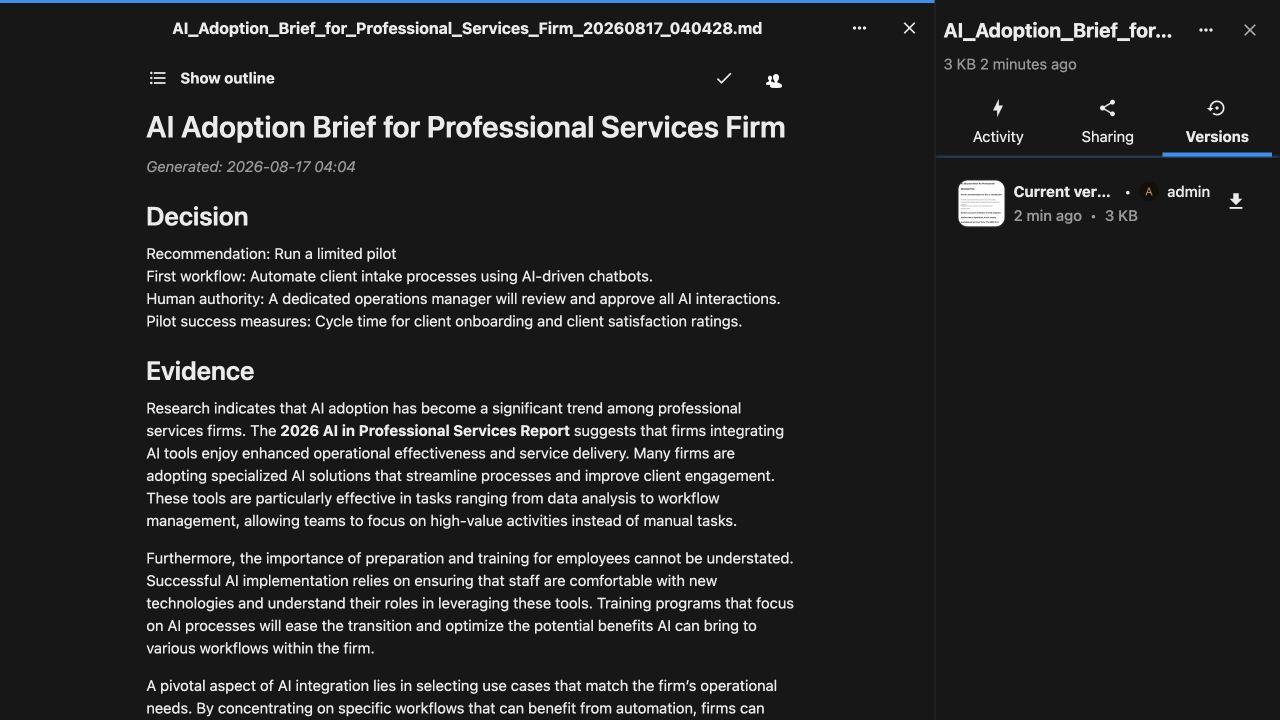
The generated decision brief persisted in Files and the requester received a direct link to the document. The artifact contained a decision, evidence, risks and controls, next steps and retrievable sources.

04 · REVIEW THE HANDOFF

Keep client communication as a separate decision.

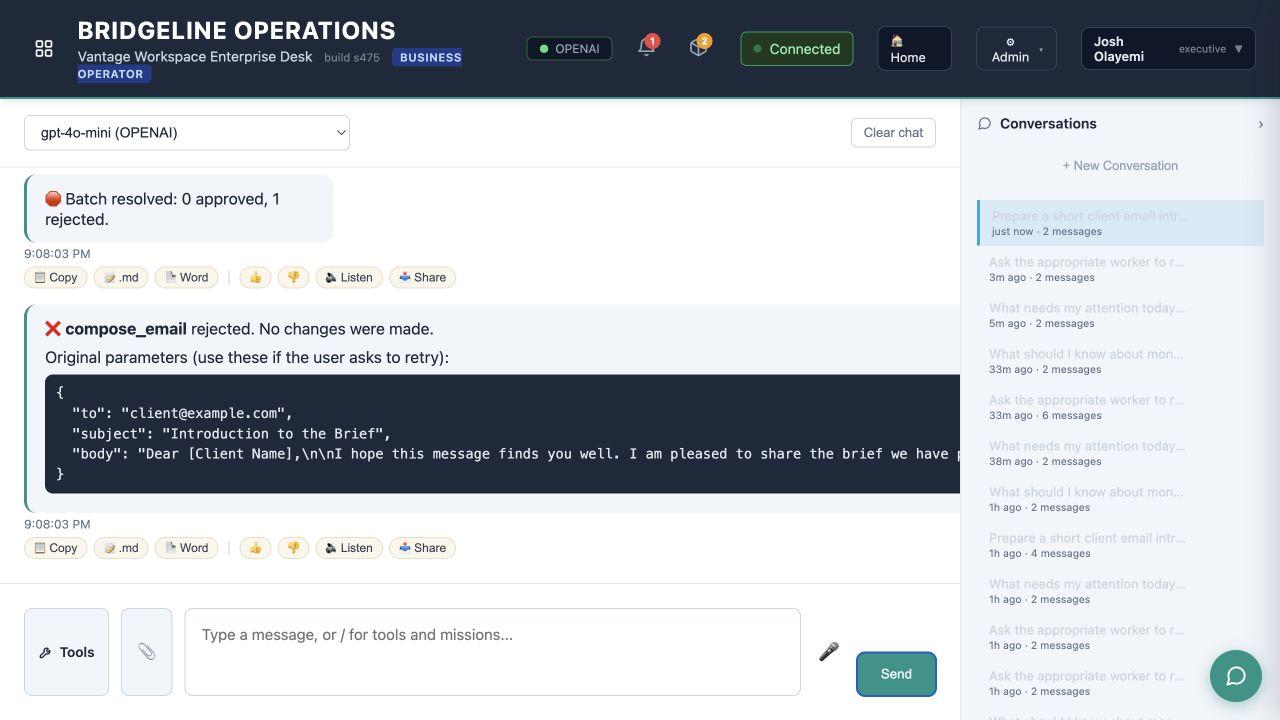
The tested flow separated a complete email preview from saving a Mail draft and from external delivery. The human could reject the action, and the workspace reported that no change was made.


DELIVERY WORK PRODUCT

The file is the handoff.

A convincing answer in chat is not client delivery. The work becomes usable when the reviewer can open the artifact, inspect the sources, correct the judgment and decide what happens next.

A client decision brief open for review in Vantage Workspace Files

WHAT THE BUYER RETAINS

  • A delivery charter naming the source boundary, worker, reviewer and rejection rule.
  • The demonstrated client-work artifact in Files.
  • A complete communication preview when that step is in scope.
  • The observed evidence, reviewer corrections and exceptions.
  • A 30-day recommendation for the next client-delivery workflow.

HUMAN AUTHORITY

A draft is not a delivery decision.

Preparation, persistence and external communication are different acts. The tested workflow exposed those boundaries instead of hiding them behind one send button.

Vantage Workspace human approval boundary for a client communication step

QUESTIONS DELIVERY LEADERS ASK

Test the source-to-review handoff before discussing scale.

How can Vantage Workspace help a professional-services firm deliver client work?

Vantage Workspace can route a bounded client question to an appropriate AI Worker, prepare a source-backed artifact, retain the result in Files and present any external communication as a separate human decision. The demonstrated path gives a reviewer a complete work product to challenge instead of an unsupported chat answer.

Will Vantage Workspace send work to a client automatically?

Not in the demonstrated Client Delivery workflow. The tested path separated a complete communication preview, saving a Mail draft and external delivery. Each consequential step remained visible to the human reviewer, and a rejected action made no change.

Can the AI Worker use our client-confidential material?

A delivery engagement starts by agreeing the source and data boundary. Synthetic or buyer-approved material is used until the permitted sources, deployment route and reviewer are clear. The public demonstration does not require real client data.

Does a source-backed artifact mean the result is automatically correct?

No. Retrievable sources make review possible; they do not remove the need for professional judgment. The reviewer checks whether the evidence supports the decision, whether important context is missing and whether the artifact meets the agreed rejection rule.

What can the workflow produce?

The demonstrated route produced a concise decision brief with a decision, evidence, risks and controls, next steps and source URLs. A buyer-specific implementation can define another bounded artifact, but source suitability and format fit are confirmed before the run.

What should we test first?

Choose a recurring client question with an approved source set, a named reviewer, a clear required artifact and an explicit reason to reject the result. Start where senior people currently spend time assembling a first reviewable version.
START WITH ONE CLIENT-DELIVERY JOB

Put the artifact and the reviewer at the center of the workflow.

Follow the synthetic client-work journey, then map one recurring deliverable with its source boundary, reviewer, required sections and rejection rule.